
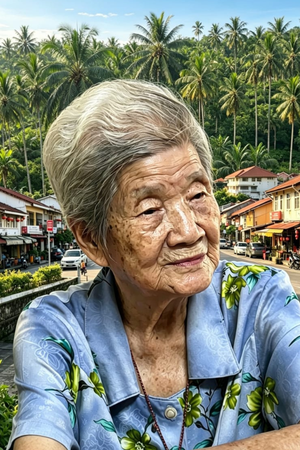
Author: Soh Chai
Written by: Her Daughter, Dato Seri Chong Eng
《She Taught Us Through Her Life What Responsibility, Diligence, Fairness, and Integrity Truly Mean》
The CEO of Our Family
Soh Chai is my mother. She was born in the 1930s, a difficult era of poverty when girls could still be sold into families as child brides.
When she was seven, her father, who had migrated from Fujian, China, decided to return to China with his eldest son and youngest daughter because of his poor health and difficulty adapting to the local climate. Soh Chai and her ten-year-old sister, Su Dou, were left behind, and both eventually became child brides. It was a childhood without a childhood. Little girls were expected to do household chores and care for younger children. There was no school for them, and the family was too poor to afford an education. Of course, in those days, boys also began working at a very young age and had little opportunity to study.
Soh Chai lived through the Second World War and the Japanese occupation of Malaya. She never actually witnessed the fighting, but she learned to remain alert. Whenever the adults told the children to hide, she knew that the Japanese soldiers were nearby. She remembered how severe the food shortages were. Every family had to grow its own rice, tapioca, sweet potatoes, and other crops to survive. When her fourth brother was born, there was no milk available. The family ground rice into powder, mixed it with hot water, and fed him rice porridge. She believed this may have contributed to why he eventually grew shorter than his siblings.
When her mother-in-law died in childbirth at the age of 17, the youngest brother was only three, an aunt was six, and her fourth brother was seven. Soh Chai had originally been expected to marry the following year, but overnight, she had to take on the role of a mother and care for the entire family. At the same time, she worked tapping rubber trees for a meagre income. Her husband, the eldest son of the family, was only 18, yet he too had to shoulder the responsibility of supporting his younger siblings and leading the household. The following year, at the age of 18, Soh Chai married the 19-year-old man who would become the father of her children. She had truly become an adult. A year later, she gave birth to their first son.
She remembered that not long afterwards, the British colonial government instructed families living scattered across their plantations to relocate to newly established villages. Each family was allocated a plot of land, and they had to source their own materials to build their homes.
“There was nothing back then. The men would cut down trees, put the pieces together, and cover the roof with thatch. At least there was somewhere to shelter from the wind and rain. During the day, they would still return to the old house in the plantation. It took a very long time before we finally had something that looked like a proper home.”
Later, the British government opened up land applications to adult villagers. My mother was granted five acres of land. It became the only asset she owned personally. Once the rubber trees matured and she began tapping them, she finally had an income of her own and, with it, a sense of security and confidence.
I still remember that when I was a child, the floor of our house was made of bare earth, the wooden walls had gaps between the planks, and the back door was barely standing. Once, strong winds actually blew it down. My mother told me, “Your father worked together with the neighbours. They cut the wooden planks one by one and transported them home on bicycles.”
When I was in Primary Three, my mother had saved every cent she earned. Eventually, she accumulated RM6,000 and renovated the house. The walls were partly rebuilt with wooden planks, giving our family of twelve a more spacious home. My parents had one room, my eldest brother had another, the six sisters shared one room, and the three younger brothers shared another. There were two living rooms, one bathroom, a well, and a toilet outside the house. There was still no electricity. We also kept chickens in the backyard.
The nine-room house we have today was later built by my father after he worked hard to develop the plantation and grow oil palms and rubber trees. After saving RM140,000 from the harvest, he finally had enough to build the house. But only three months after construction began, his persistent cough was diagnosed as terminal lung cancer rather than tuberculosis. My eldest brother immediately urged the contractor to complete the house as quickly as possible. Three weeks after the new house was completed, my third brother held his wedding. Soon after the wedding, my father passed away.
My mother always said that she personally paid for the interior furnishings and renovations. She could neither read nor write, yet she was remarkably resourceful. Without being taught, she learned to sew clothes for her children, build chicken coops, repair simple furniture, grow vegetables, raise pigs, cultivate rice, and do almost anything that needed to be done. The only thing she never learned was how to ride a motorcycle.
She never went to school, but she had her own way of handling money, and she was never careless with a single cent. Even in her nineties, her memory remains stronger than mine. She remembers the birthdays of all ten of her children clearly, using her own unique system. Had she been born into a more privileged environment, I sometimes wonder whether she might have become a “super brain” in her own right.
She could not read or write, and was afraid to travel far on her own. She could not take public transport by herself. The furthest she would travel alone by bicycle was to the town of Triang, about three miles away, to buy daily necessities. Her world was largely limited to the family home, the rubber plantations, and the surrounding village. Yet she possessed a deep wisdom about life. She spoke carefully and often reminded her children never to talk excessively, never to look down on others, and always to treat every child and every daughter-in-law fairly.
She was responsible for feeding, clothing, and educating all ten children. My father made the major decisions. Once, when someone suggested that their fifth daughter could be given to an aunt to raise, he simply replied, “A human being is not a cat or a dog. How could we give our child away?” My father also owned a hunting rifle and would occasionally hunt wild boar, helping to provide meat and protein for the family.
My mother was also responsible for paying the children’s school fees. Yet every child contributed in his or her own way. All of us learned to tap rubber trees. Even during university holidays, we had to return home and work in the plantation. After graduating and starting our careers, we still had to come home on weekends and follow her instructions—whether it was spraying, weeding, applying fertiliser, or supervising workers harvesting the oil palm fruit. Even today, well into her nineties, she remains the CEO of our family, managing the dozens of acres of oil palm and rubber plantations left behind by our father.
Her youngest unmarried daughter is her assistant. She helps manage the plantations, handles bank matters, coordinates with plantation workers, and remains on standby whenever the CEO needs her. She also takes care of the small vegetable garden beside the house, growing vegetables, gourds, and beans—all according to the CEO’s decisions. As for breakfast, lunch, and dinner, as well as how many dishes should be prepared during Chinese New Year and other festive occasions, the CEO still has the final say. And her children willingly follow her decisions.
The CEO never went to school, yet among her children are a master’s degree holder, an engineer, a Member of Parliament, technical professionals, and a tailor. All of them have lived responsibly, obeyed the law, and taken care of their own families. How did an illiterate woman accomplish all this? She would probably sigh and say, “Those years were hard. The hardship is impossible to describe in just a few words.”
She never went to school. She could not read or write. She did not understand the science of photosynthesis. But she had an unwavering determination to raise her children, the leadership and management abilities of a true CEO, and, most importantly, wisdom about how to conduct oneself as a human being. She also carried the resilience, acceptance, and sense of duty that were characteristic of women of her generation.
She never preached great philosophies. Instead, she educated her children through the way she lived, the way she treated people, and the way she carried herself. In doing so, she earned the respect of her children and secured for herself a later life free from worry about food and shelter.
After a lifetime of hardship, she has finally tasted the sweetness that comes after bitterness.
Her life is a quiet but powerful reminder: 《Education may shape a person’s knowledge, but character, responsibility, perseverance, and wisdom can shape an entire family》.